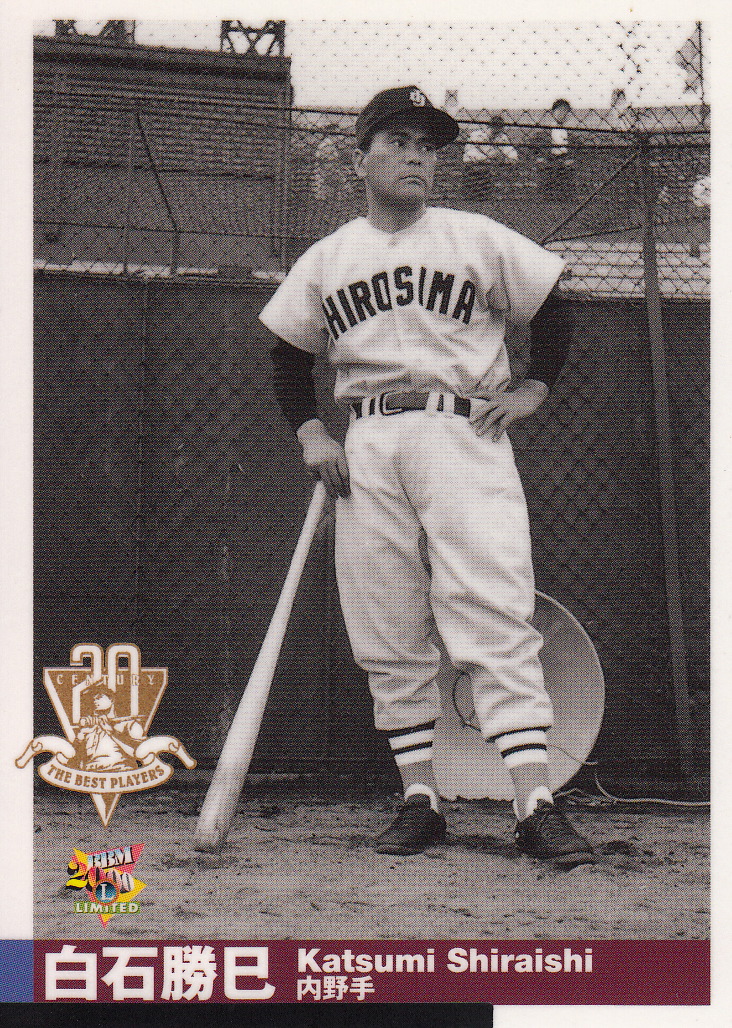
The Carp were one of the new teams added in 1950 when single league system (the Japan Baseball League or JBL) transformed into the two league system (Nippon Professional Baseball or NPB). Initially their name was simply the Hiroshima Carp - they changed it to the current name of Hiroshima Toyo Carp in 1968.
Notes - there are a LOT of disagreements between HOU and PBUE - especially with the late 50's uniforms. I kind of went with what made the most sense to me but I could have messed stuff up.
The home uniform in 1958 and 1959 is exactly the same except that PBUE says there was a different cap in 58 (an interlocking "HC" design) than 59 (the stylized "ch" design used with the away uniforms). HOU only mentions the '58 hat. Neither source indicates the hat with just the "H" on it shown on the Kozuru card. I have a number of menko cards that show this hat so I'm not sure why neither source has it.
The home uniform for 1960-62 looks very similar to the home uniform from 1958-59 except that it has a number on the front. So the photo on that card for the Carp's history from 1960-69 is from 1959!
Finding cards for players from the 50's was challenging - the Carp pretty much stunk during this time and didn't have a whole lot of stars. So appearances of 50's era Carp players in the OB sets was pretty much restricted to Katsumi Shiraishi and Ryohei Hasegawa.
The home uniform from 1954-56 and 1956-57 (the one I show Hasegawa in) only differed by the appearance of "HIROSHIMA" on the left sleeve. I assumed that the uniform Hasegawa is shown on the 2014 Pitchers Spirit Of Carp card is from the 1956-57 era since it looks like there's something on his left sleeve, but I could be wrong.
Some of the away uniforms in the late 50's and early 60's said "HIROSIMA" on them instead of "HIROSHIMA". Not quite sure why this happened but it's similar to the uniforms from around the same times for the Lions ("Nisitetu" instead of "Nishitetsu") and the Pearls/Buffaloes ("Kintetu" rather than "Kintetsu").
HOU says that the 1963-67 Away uniforms had the player's number on the left sleeve. I've seen photographic evidence that the number appeared on either sleeve.
The home and away uniforms from 1968-70 only differed from the 1963-67 ones by the addition of the word "TOYO" on the left sleeve.
PBUE uses photos to illustrate the uniforms - I used five cards that share photos with the PBUE in this post.
The NPB All Star rosters were released this past week and one of the selections by Central League (and Yomiuri Giants) manager Tatsunori Hara sparked a little bit of controversy. Hara left the current Central League home run and RBI leader - Kazuhiro Hatakeyama - off the roster and included pinch running specialist Takahiro Suzuki of the Giants instead. Hara's explanation for leaving Hatakeyama off the roster is apparently that since he "has" to include Shinnosuke Abe as catcher (he was elected on the player's ballot) but he doesn't want Abe to actually catch (Abe was supposed to move to first full time this year but he's actually played twice as many games at catcher than first base so far) so he's effectively ended up with three first basemen on the roster - Abe, Takahiro Arai of the Carp (the fan's ballot winner) and Jose Lopez of the Baystars (the player's ballot winner). Including Hatakeyama would have given him four first basemen and he wanted a little more roster flexibility than that. Which makes sense (it's similar to the numbers games that kept Rafael Palmiero off the AL All Star team in the mid-1990's - it was hard to break through the Mark McGwire-Frank Thomas-Mo Vaughn-Jim Thome-Tino Martinez blockade at first) except for it not explaining why he would pick Takahiro Suzuki. At this point in his career, Suzuki is basically only a pinch runner. He's gotten into 30 games this season but only had 11 plate appearances. He's never really been a regular (he's only had 10 BBM flagship cards in the past 15 years) and there are more deserving outfielders not on the roster - Yuhei Ohshima of the Dragons or even Kosuke Fukudome of the Tigers to name two.
Well, anyway, here's a card of Hatakeyama from the "The Brightest Hope" subset from the 2005 BBM Swallows team set:
BBM updated their website last week while I wasn't looking and published information on a number of upcoming sets:
- I previously wrote about this year's Baystars set and said that it would be out in late June. BBM ended up delaying publication of the set for a month - it will now be out on July 17th. There doesn't seem to be any more information about the set on the website than there was in SCM last month.
- The final two team sets for the year - the Lions and the Giants - will be released in the next few weeks. Both of them have the "standard" 81 cards in their base sets that all the other team sets have had this year. The Lions base set has 69 cards for the players (and manager), three "combo cards", six "puzzle cards", two "2014 Award Winner" cards and a checklist card. There will be two nine card insert sets - "Raging Lions" and "Mighty Lions" - and the usual boatload of autograph cards - including ones with multiple players and "1 of 1" parallels. The Lions set will be out July 11th. The Giants base set has 70 cards for the players (and manager), a mascot/checklist card, three "Master Skill" cards and seven "Star-to-Be" cards. There are six different insert sets - "Giants Pride" (9 cards), "Golden Hill" (3 cards), "Glorious Leader" (3 cards), "Great Bond" (3 cards) and "TRIPLEX" (3 cards). There's a bewildering number of parallels for each of the inserts (as well as the player cards). Some of them appear to be limited to the player's uniform number. The "Giants Pride" cards have metallic parallels - either silver or gold. The "TRIPLEX" cards are 3d and are limited to 25 cards apiece. There are also memorabilia cards - undershirts and bats - that include multi-player cards. The set will be out on July 15th.
- The latest team box set from BBM will be the Hawks "Autographed Edition" set (possibly a reaction to last season's "Signature Edition" sets from Front Runner?). This set will contain 28 cards - a 27 card base set plus one autographed card. Cards with autographs from multiple players are possible. I'm not entirely sure, but I think there's some sort of "secret parallel" as well - I don't know if this means there's a parallel version of the autograph card or if there's a possible parallel to one of the base cards available as well. This set hits the stores on July 24th.
- This year's 2nd Version set will be out on August 2nd. Unlike the 1st Version set, this year's edition potentially has more cards in it than last year's. This year's base set has 216 player cards (18 for each team) which has been the standard for the last six years. There's also three subsets - a 36 card "1st Version Update" (3 per team), 12 team checklists and 36 more of the "Cross Plasma" cross set subset (3 per team) - plus the standard "1st Pitch Ceremony" subset although as usual BBM is not saying how many cards will be in this subset. The total size for the base set is 300 cards and counting - last year's set was only 301 cards. There's one 12 card insert set ("Future Legends") and a variety of autograph and memorabilia cards. There is an amazing variety of parallel issues that will make your head swim - 72 of the player cards (six per team) have five different signed parallel versions with varying levels of scarcity, there's two different parallels for the "Cross Plasma" sets, and some sort of parallel for the "1st Pitch Ceremony" and "Future Legends" cards.
The event started around 7 in the evening. Rob, Mashi and documentary film maker Yuriko Gamo Romer were introduced and came out and sat up at the front of the room. After some preliminary comments from Rob, they ran a short clip from Yuriko's current work-in-progress - a film on US and Japanese relations over baseball that is centered around Mashi called "Diamond Diplomacy". Rob then gave a talk describing the contents of the book, illustrated with a slide show and punctuated with comments from Mashi. For example, Rob pointed out that Mashi's first base hit in the majors was off of Sandy Koufax. Mashi then described the at bat in which he got the hit - a bunt up the third baseline - and expressed disappointment that he didn't get the ball. (To be complete, Mashi's only other major league hit was off of Ted Davidson of the Reds - in fairness to him, as a relief pitcher he didn't get many at bats - only 16 in the 54 games he appeared in.) Once the presentation was completed, Rob and Mashi took a couple questions from the crowd but they only had time for maybe three before they needed to get set up for the autograph session. There were a lot of people at the event (one of the Barnes & Noble employees said that it could properly be referred to as a "throng") so there was a lot of autographing to be done. Mashi was kind enough to sign both my copy of the book (that Rob had already signed as it was my premium for having donated to his Kickstarter campaign) as well as a promo baseball card that Rob had had printed up for the book:
Here's some photos from the event:
Outside the Barnes & Noble
Sign for the event
Yuriko, Mashi and Rob being introduced by the Barnes & Noble employee
Rob at the podium
Watching the clip from "Diamond Diplomacy"
Rob's presentation
Signing
More signing
The evening turned even more special afterwards. I had sent an email to Rob last week asking if it would be possible to ask Mashi a few questions about baseball cards either before or after the event. Not only was Rob gracious enough to agree, he invited me to join them for dinner at a nearby restaurant after the event. He arranged the seating at the table so that Bob, a gentleman that had contributed enough to the Kickstarter campaign that his reward was getting to basically spend the day with the two of them, and I were seated with Mashi and Yuriko. Mashi's English is quite good and Yuriko translated whenever there were any issues with understanding. One thing that I learned was that Mashi had had no idea that there were baseball cards of him produced during his career - Rob had given him his Kabaya-Leaf card a few days previously and he had never seen it before. He said something that Yuriko translated as "they have to ask permission now" but although I was curious about how BBM and Epoch contact OB players for their sets, I decided not to ask too much. It was a bit noisy and I sensed (and he confirmed) that Mashi was a bit tired and jet lagged - he arrived in Chicago last Friday from Japan and had traveled to Boston before arriving in New York. I had a great time talking with him, Bob, Yuriko and a friend of Yuriko's at dinner however (Rob was at the other end of the table with his wife and some friends of the family so I didn't talk a whole lot with him during the meal). I'm very grateful to Rob inviting me along and I hope I didn't bug Mashi too much.
I want to close by talking a little bit about "Diamond Diplomacy". The clip that Yuriko shared was very interesting, talking about the introduction of baseball in Japan by Horace Wilson in 1931, followed by some clips of the 1934 MLB All Star and the 1949 Seals tours before moving into the Mashi story. At dinner I asked Yuriko about the clips from the 1949 Seals tour - I was surprised to see that she had color footage. She said that the father of a friend of hers was a player on that tour and that they were home movies of his. She added that her project originally was going to only be about the Seals tour but as she learned more about the context of the tour, the project grew much broader. I really look forward to seeing the final film.
She had promo postcards for the film at Barnes & Noble:
I also found this clip of hers on YouTube that shares some of the footage with what she showed last night:
The tour continues with stops in Rhinebeck, NY and at the Hall Of Fame in Cooperstown this weekend before going to California next week.
Ever see a guy hit a home run completely out of a domed stadium? That's what Ernesto Mejia of the Lions did during their 12-4 shellacking of the Fighters on Friday night. He hit a two run home run to left center that completely left the Seibu Dome. This was only possible because Seibu Dome is open on the sides - it was a standard open air ballpark until they put a roof on it back in 1999. Here's a link to Pacific League's video of the home run and here's Mejia's first BBM card:
2014 BBM 2nd Version #413 (1st Version Update subset)
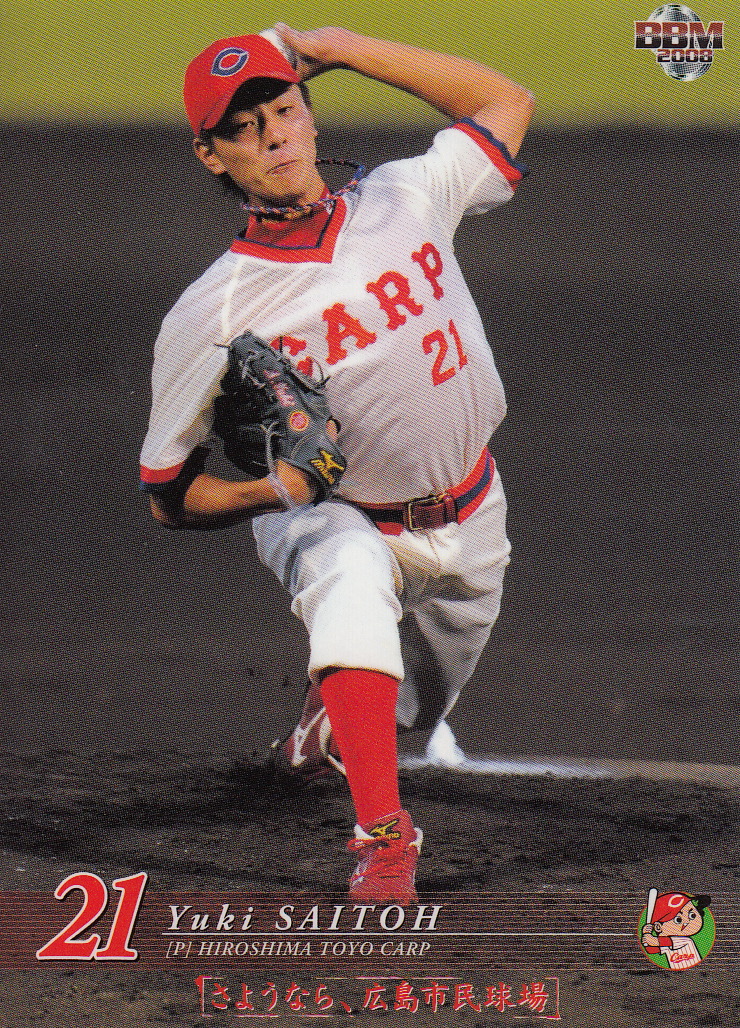
Friday night's game had a number of interesting features. Shogo Akiyama had the difficult three quarters of a cycle in his first four at bats - triple, home run and a double - but could not get a single in either of his last two at bats. And Fighters manager Hideki Kuriyama left Yuki Saitoh in to take a pounding in the sixth inning - Yu-chan faced 10 batters and gave up 7 hits, including home runs to Hideto Asamura and Tomoya Mori and three doubles. He also walked a batter. He gave up five runs and would have given up more probably had Takumi Kuriyama not gotten greedy trying to go to second on a throw to the plate after singling. Kuriyama also let rookie starter Kohei Arihara take a bit of pounding as well - 10 hits (including the home runs by Akiyama and Mejia) and six runs (only five earned) over five innings.