Sunday, June 21, 2020

Card Of The Week June 21

One of the likely outcomes of the current negotiations between MLB and the player's association will be the adoption of the Designated Hitter in the National League.  While this officially will be temporary I think most people figure it'll be permanent.  Which means that very soon the only baseball league in the world that has not adopted the DH will be the Central League in Japan.

On Opening Day on Friday the Central League starting pitchers tried to prove that this would not be a bad thing.  As this post on NPB Reddit points out, the starters went 5-for-11 at the plate with a double, 2 home runs and 5 RBIs.  Most of that was from Yuki Nishi of the Tigers (2-2 with a double and a home run and two RBIs) and Daichi Ohsera of the Carp (2-3 with a home run and three RBIs plus a complete game victory).  (Tomoyuki Sugano got the other hit by pitcher that day.)

I thought I'd share cards of Nishi and Ohsera from BBM's Icons sets.  Ohsera's card is from the 2018 Icons - Fanfare set (#19) while Nishi's is from last year's Icons - Teenage Memories set (#36) - this was Nishi's first appearance on a BBM card in a Tigers uniform:


Friday, June 19, 2020

Latest Mandarake Mail Day

Recently I placed yet another order for vintage Calbee cards from Mandarake, the chain of antique toy stores in Japan that ships to the US and the cards showed up today.  As usual I'm astonished by how inexpensive these great cards are.  Here's what I got in this latest package:

I'm a sucker for vintage Tsutomo Wakamatsu cards as I think almost every order I've gotten from Mandarake has had a card of him in it.  I'm especially a sucker for Yakult Atoms cards so I had to pick this one from the 1973/74 set up.  It was 500 yen and Mandarake listed it as being in "below average condition".  It has a pencil mark on the back but other than that it looks in great shape for a 46 year old card.

1973/74 Calbee #306
I decided to pick up some vintage Hiromitsu Kadota cards since he's another favorite of mine.  For some reason I always find it amazing that someone who appeared in Calbee's first set in 1973 also appeared in BBM's first set in 1991 even though there's only an 18 year gap.  I should sit down sometime and figure out if there are any other players in both sets.

I ended up with four Kadota cards.  This first one is from the 1973/74 set and was also 500 yen.  Mandarake listed its condition as "average".

1973/74 Calbee #313
The next one is also from the 1973/74 set and was 300 yen.  Mandarake says "there are some problems" with its condition but other than some wear on the edges the card looks pretty good.  This is one the "Exciting Game Series" cards and shows Kadota batting in Game 5 of the 1973 Nippon Series on November 1, 1973.  That's Giants catcher Takashi Yoshida crouching behind him.

1973/74 Calbee #325
This next card is from the 1974/75 Calbee set and is similar enough to the last card that I almost didn't buy it.  But since it was only 100 yen I decided I couldn't resist it.  This is another card that Mandarake lists as "Below average condition" but again I don't see it. 

1974/75 Calbee #849
The back of this card appears to say that the photo is from a game on May 31st (1974 I assume) at Osaka Stadium but if that's the case, why is Kadota in an away uniform and the catcher in a home Taiheiyo Lions uniform?


The last Kadota card I got is from the 1975/76/77 "monster" (as Sean puts it) set.  I guess that technically it's a card of Toshiharu Ueda, manager of the Hankyu Braves, who is in the center of the photo.  Kadota is on the right side of the photo and Takeshi Koba, manager of the Hiroshima Toyo Carp, is on the left.  Ueda and Koba were the opposing managers in the All Star games in 1976 and this photo is from All Star Game #3 played on July 20, 1976 at Osaka Stadium.  Mandarake listed the card's condition as "average" and priced it at only 100 yen.  It looks great to me.

1975/76/77 Calbee #865
I got a couple more cards from the "monster".  Here's a card showing Yutaka Fukumoto of Hankyu being congratulated by his teammates.  This card is in fantastic shape with very sharp corners but Mandarake listed its condition as "good" and priced it at 200 yen.

1975/76/77 Calbee #595
I was excited to find this next card.  Sean had written a post a while back about the last series of cards from the "monster" that included cards labeled as "77 Central Pacific Rival Player Series".  Each Rivals card showed two players - one Central League player and one Pacific League player - that had something in common.  Not only did I not have any of these cards, I didn't even know they existed until Sean's post.  I was able to pick up this one showing Kenichi Yazawa of the Dragons and Satoru Yoshioka of the Lions.  Mandarake listed the condition as "damaged" but again it looks great.  It was only 500 yen.  (Note - My scan cut off a little of the bottom of the card.)

1975/76/77 # 1412
I'm amused that despite Yoshioka appearing on the front of the card in Taiheiyo Club Lions uniform, the back of the card shows a Crown Lighter Lions flag.  The Lions changed their name in October of 1976.


The last two cards I got were both from the 1981 set.  Both of these cards were 100 yen each and have a condition of "common".  They both look fantastic.  The first is another card of Yutaka Fukumoto.  

1981 Calbee #77
The other card is of Makoto Shimada.

1981 Calbee #97

The subtotal for the nine cards was 2400 yen.  Shipping options are still limited from Japan so I ended up paying 1360 yen for DHL, about twice as much as I would have paid for SAL shipping under normal circumstances.  The total price then was 3760 yen which worked out to around $36.50.  That's just a little more than $4 per card which is pretty awesome for the cards involved.  And DHL shipping is amazingly fast - I placed this order Monday evening and the cards showed up today (Friday) at around 1 PM.

Play Ball! (2020)

I'm continuing my Opening Day tradition of doing a post showing a baseball card from the last year that each of the 12 NPB teams won the Nippon Series - inspired by the series of posts that Night Owl Cards has been doing for a while now for MLB teams.  In a different world this would have happened in March but better late than never:

The last time the HAWKS won the Nippon Series, cards looked like this:

2019 Epoch One #193/SH-024
The last time the FIGHTERS won the Nippon Series, cards looked like this:

2016 BBM/Nippon Ham Home Run Sausage #2016N-137
The last time the EAGLES won the Nippon Series, cards looked like this:

2013 BBM Eagles #E16
The last time the GIANTS won the Nippon Series, cards looked like this:

2012 BBM 1st Version #229
The last time the MARINES won the Nippon Series, cards looked like this:

2010 Marines Team 26
The last time the LIONS won the Nippon Series, cards looked like this:

2008 BBM Lions Classic #23
The last time the DRAGONS won the Nippon Series, cards looked like this:

2007 BBM 2nd Version #606
The last time the SWALLOWS won the Nippon Series, cards looked like this:

2001 Future Bee Swallows #Ys-3
The last time the BAYSTARS won the Nippon Series, cards looked like this:

1998 BBM Diamond Heroes #23
The last time the BUFFALOES* won the Nippon Series, cards looked like this:

1996 Calbee #39
The last time the TIGERS won the Nippon Series, cards looked like this:

1985 Calbee #24 (Akinobu Mayumi)
The last time the CARP won the Nippon Series, cards looked like this:

1984 Calbee #165 (Mitsuo Tatsukawa)
*The Buffaloes were called the BlueWave in 1996

All 12 current NPB teams have won the Series at least once so there are no "Photo Not Found" teams.

Sunday, June 14, 2020

Card Of The Week June 14

I noticed something odd the other day about the recent Calbee sets.  It's not unusual in a given year for a player to appear in one (or more) of Calbee's subsets but not actually appear on a "regular" player card that year.  For example, last season Hotoka Yamakawa of the Lions was in the "Title Holder" subset from Series One and the "Exciting Scene" subset from Series Three but he didn't have an actual non-subset card in any of the three Series.  A quick look at last year's checklists reveals that there's 13 players who fell into this category include Yudai Ohno, Takayuki Kishi, Shota Imanaga, Daichi Ohsera and Tomoyuki Sugano.

It was Sugano who caught my eye because I noticed that not only had he not had a "regular" Calbee card in 2019, he didn't have one in 2018 or 2017 either.  Before this year his most recent "regular" Calbee card had been in the 2016 set.  I've never really looked all that hard but I don't know of any case where that big of a name didn't have a regular Calbee card three years in a row.

Now to be fair - 2017 was an unusual year since Calbee only issued two Series instead of the usual three due to the Hokkaido Potato Crisis so there was a larger than than normal number of players who didn't have "regular" player cards that year including Shohei Ohtani, Tetsuto Yamada, Yoshitomo Tsutsugoh, Hayato Sakamoto, Takehiro Norimoto, and Yuki Yanagita.  Sugano had a "Title Holder" card that year, an "Exciting Scene" card in the 2018 set and "Title Holder" and "Starting Pitcher" cards in 2019.

I thought I'd share his last two "regular" Calbee cards - one from 2016 and the other from this year:

2016 Calbee #046

2020 Calbee #039

Thursday, June 11, 2020

Summer Releases

I wanted to do just a quick roundup of the couple new sets that have been announced recently...

- Calbee's Series Two set will officially be released on July 6th but it's usually available a few days before that.  The base set will have 87 cards, one card fewer than expected.  There will be 72 player cards (6 per team), a 12 card "AVG Leader" subset and 3 checklist cards (this is where the missing card was taken from - usually there's four checklist cards).  After not being in Series One the "Star" insert cards have made a comeback - there will be 24 of them (2 per team).  There's also a 12 card "Wins Leaders" box set available via a "Lucky card" redemption.  The checklist for the set is available here.

- The last of BBM's annual comprehensive team sets is for the Dragons and it will be released in mid-July.  This set will have the standard sized 81 card base set that includes 69 cards for the players and manager along with three four card subsets - "The Contenders", "First Impact" and "Before Dawn".  There are also 36 insert cards split across four sets - "Front Line" (9 cards), "Boost Phase" (5 cards), "Sky's The Limit" (4 cards) and "Phantom" (18 cards).  I assume each "Phantom" card is serially numbered to 25 although the web page doesn't explicitly say that.  There's also a variety of autographed cards available.

- Epoch is coming out with two of their combination active/OB team sets under the "Stars & Legends" label, one for the Lions and one for the Tigers.  These are both examples of Epoch's ultra-high end sets as boxes for them retail for 16,500 yen (around $155) and contain four cards - although two of them will be autograph cards.  Each set will have a base set containing 47 cards split between current and OB players.  For the Lions there are 27 current players and 20 OB players and for the Tigers there are 36 and 11 respectively - although those numbers may change.  Each set has two insert sets - Gem (6 cards) and Black Gem (6 cards) - I think these are Epoch's version of BBM's "Phantom" inserts as every set appears to have them.  There's also a plethora of autographed cards available for each set.  Both sets will be released on August 1st.

Monday, June 8, 2020

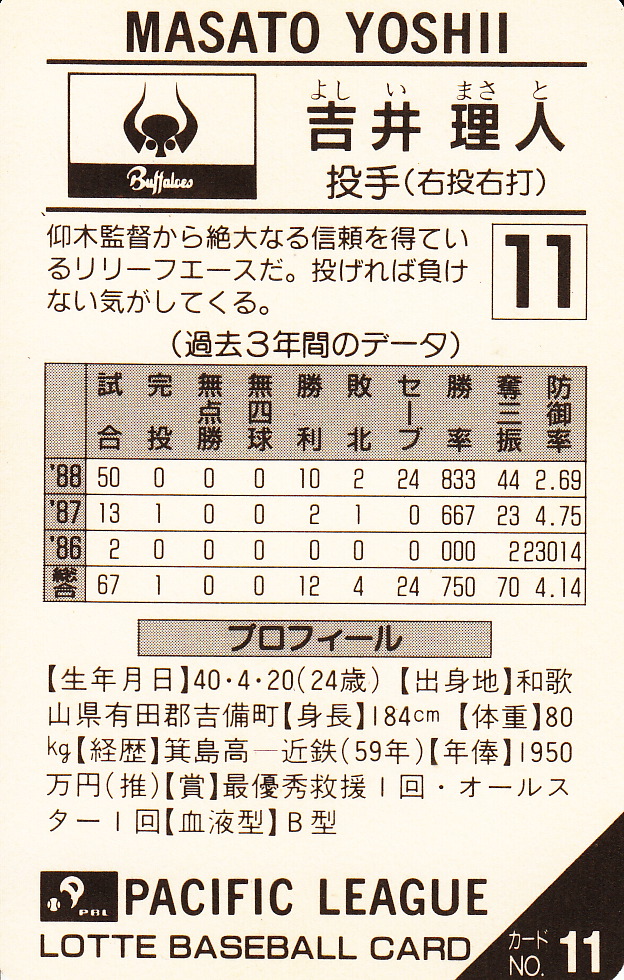
1989-90 Lotte Gum sets

Lotte, the same company that owns the Marines in Japan and the Giants in Korea, issued two 120 card sets in 1989 and 1990.  Both sets were issued in packs containing a single card along with two pieces of gum.

The 1989 set featured borderless photos with the player's name and team on the front in Japanese.  The corners of the cards are rounded.  They very much resemble the "phone card" size Calbee cards from 1990-91 except Calbee had the player names in English.  (In fact when I first saw the set years ago I kind of thought that Lotte was ripping off Calbee's design until it clicked with me that they came out first!)  The backs of the cards feature the player's name in English.  I suspect this is the first Japanese set to have the player's name in English on it.  Calbee added English names to the back of their cards in their third series in 1989 and I wonder if it was in response to Lotte having them.

The set contains the stars of the day including Hall Of Famers Koji Akiyama, Tatsunori Hara, Tsutomu Itoh, Hiromitsu Kadota, Manabu Kitabeppu, Kimiyasu Kudoh, Choji Murata, Hiromitsu Ochiai, Yutaka Ohno, Kazuyoshi Tatsunami and Tsunemi Tsuda along with other stars like Kazuhiro Kiyohara, Norihiro Komada and Takehiro Ikeyama.  There's a large number of Western players in the set including Greg "Boomer" Wells, Ralph Bryant, George Hinshaw, Mike Diaz, Mike Easler, Brian Dayett, Anthony Brewer, Willie Upshaw, Tony Bernazard, Carlos Ponce, Jim Paciorek, Larry Parrish, Matt Keough and Cecil Fielder.

Half of the cards in the set has some sort of variation.  Most of these are either variations on the English spelling of the player's name ("Ito" vs "Itoh" or "Fieldar" vs "Fielder") or the player's weight but there are two different versions of the front of Bryant's card and two completely different versions of card #29 - one is Easler and the other is Dayett.  You can see the full checklist for the set over at TradingCardDB.com.  Here's some sample cards:

#9 Koji Akiyama

#40 Hiromitsu Kadota

#106 Takehiro Ikeyama

Back of #11

Wrapper
The fronts of the cards in the 1990 set have white borders and feature the player's name in English on them.  Again I believe that this is the first time that the player's name appeared in English on the front of a Japanese card.  Calbee started doing this with their second series of cards that year (which was also when they changed the size and shape of their cards to match the 1989 Lotte set).  The cards had the more traditional sharp corners rather than the rounded corners.

The checklist for the 1990 set was very similar to the 1989 set - in some cases literally.  A number of players have the same number in both checklists.  The 1990 set contains the same 11 Hall Of Famers that the 1989 set had plus Masaki Saitoh.  Hideki Irabu appears in this set as well.  There doesn't seem to be as many Westerns in this set however, only Bryant, Wells and Diaz.  Neither of the big rookies from 1990 - Hideo Nomo and Atsuya Furuta - appear in the set.  There's only one known variant - there's an extremely rare version of card #117 for Cecil Fielder.  It appears the card was pulled when Fielder returned to the US in early 1990.  The more common version of the card is for Katsuhiko Kido.  The full checklist can be see at TradingCardDB.com.  Here's some example cards:

#57

#36

#67

Back of #82

Wrapper
Engel rates both sets as having a scarcity factor of "R1" which means "between 250 and 1,000 copies known of most cards".  My feeling is that the 1989 cards are less common than the 1990 ones which is a shame because I think the 1989 cards have better photographs.

Sunday, June 7, 2020

Card Of The Week June 7


Rob Fitts has just published an eBook called "An Illustrated Introduction To Japanese Baseball Cards".  It's a 82 page pdf that covers the history of Japanese baseball cards from the 19th Century to the present.  As the title suggests, it's lavishly illustrated with examples of cards throughout the years.  If you follow the above link you can see some sample pages and download the book - it costs $4.99. 

The background of the cover photo is a 1977 Yamakatsu card of Tsutomu Wakamatsu.  It's from the JY3 set, one of the oversized sets Yamakatsu did in 1976-77 - it measures roughly 6 3/4 inches by 9 3/4 inches.  I thought I'd share the what the original card looked like: