Sunday, January 6, 2013

Card Of The Week January 6

From a post in Yayku Baka this past week about Samurai Japan's manager Koji Yamamoto:
Palm reader Shuhei Shimada looked at an photo of Yamamoto's palm and provided Sponichi with the following reading:
The Fate Line (運命線), Sun Line (金運線), and Mercury Line (財運線) intersect, which means strong luck.  Could be a strong affinity to gold, which could mean a gold at the WBC.
The Life Line (生命線) splits in two, so it means there will be a journey.  It might be indicating a journey outside of Japan.  The line is also doubled, which means strength.  The IkeIke Line (イケイケ線) means new challenges tend to end well.  The crisscrossing lines (神秘十字) near the center of the palm shows a mysterious strength that helps protect.  Good with luck.
The Volunteer Line (ボランティア線) near the base of the index finger shows he is selfless and could mean he will be good at creating an environment that makes it easier for players to perform.  He also has a Mood-maker Line (ムードメーカー線), which could help with the atmosphere in the dugout.
In considering other information, like his birthday, his luck will increase in March.  His lucky color is red.  Wearing something red, even undergarments, could be good.
Well, if he wears some of his old uniforms, he should have the red covered pretty well:

2001 BBM #514

Saturday, January 5, 2013

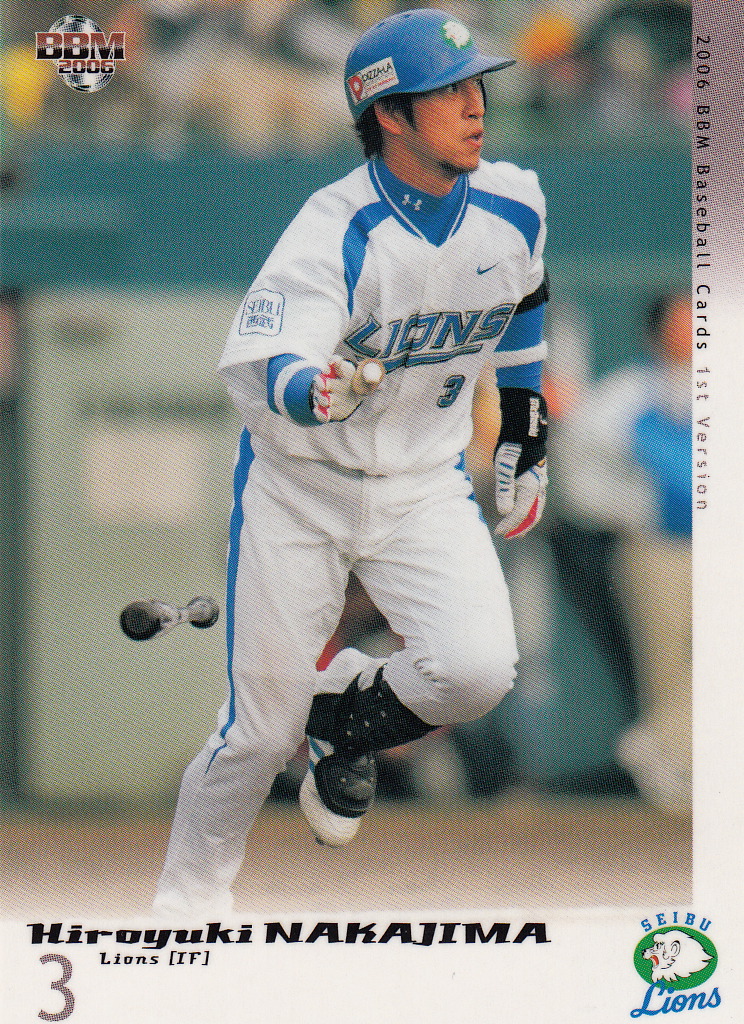
Hiroyuki Nakajima Of The Oakland Athletics

Former Saitama Seibu Lions shortstop Hiroyuki Nakajima signed a two year contract with the Oakland Athletics a couple of weeks back.  Nakajima was drafted by the Lions out of high school in the fall of 2000.  With Kazuo Matsui ensconced at shortstop for Seibu at the time, Nakajima didn't get a whole lot of playing time with the ichi-gun squad.  After 2003, however, Matsui departed for the Mets, creating an opportunity for Nakajima to show the Lions what he could do.  He hit .287 with 27 home runs and 90 RBIs and helped the Lions win their first Nippon Series since 1992 (12 years might not seem like a long time, but the Lions had won 8 Nippon Series in the 12 years from 1980 to 1992 so there was a noticeable drop off in the frequency of championships).  He would never hit that many home runs again in a season, but he's been one of the top shortstops in NPB since 2004.

His BBM rookie card is #426 from the 2001 set.  His only other card from 2001 is from a company called Broccoli who put out several sets for the Lions from 1999-2001, mostly I think to capitalize on the popularity of Daisuke Matsuzaka.  For the next two years, the only card of him that exists is from the 2003 BBM Seibu Lions team set.  Starting in 2004, however, he became a regular in each of the BBM 1st and 2nd Version sets.   2004 was also the first year he appeared in a Calbee set.

Nakajima has appeared in two Nippon Series with the Lions - 2004 and 2008 - and therefore appears in the corresponding BBM Nippon Series sets.  He won a "Outstanding Player" award in the 2008 Series so he has two cards in that set.  He has made the All Star team eight of the nine years he's been a regular, missing only in 2005, so he appears in the corresponding BBM All Star sets.  He played for the Japanese National Team in both the 2008 Olympics and the 2009 World Baseball Classic so he has a card in the 2008 BBM Team Japan set as well as a couple cards in the various WBC sets from Topps.

As always, this is not a comprehensive list, just some of the highlights.  Check SportsCardForum's Inverntory Manager for a much more complete list.

Here's some example cards:

2001 BBM #426

2004 BBM Pacific League Playoffs #P25

2005 Calbee #001

2006 BBM 1st Version #88

2007 BBM All Stars #A22

2008 BBM Nippon Series #S60 (Outstanding Player Award)

2009 Topps Chrome WBC Inserts #W62

2010 BBM 1st Version Cross Stream #CS138

2011 BBM Lions Classic #16

2012 BBM 1st Version Best 9 subset #363

Friday, January 4, 2013

Chang-Yong Lim of the Chicago Cubs

Time to get caught up on the signings of the last month...

Former Tokyo Yakult Swallow reliever Chang-Yong Lim has signed a two year deal with the Chicago Cubs.  Lim will actually spend the 2013 season rehabbing after elbow surgery last July and is not expected to pitch for the Cubs until 2014.

Lim, of course, is Korean and pitched in the KBO before coming to the Swallows after 2007.  He made his debut with the Haitai Tigers in 1995.  He was traded to the Samsung Lions in the 1998-99 offseason and remained with them until he came to Japan after the 2007 season.  He joined the Swallows for 2008 and has spent the last five seasons with them.

I initially thought that there were no cards of Lim from his time in Korea but it turns out that there are.  For some reason, he's identified in the Teleca cards from 1999 and 2000 as "Im Chang Yong" rather than "Lim Chang Yong" (Unless there's an amazing coincidence that there were two guys on the Samsung Lions in 1999 and 2000 that had almost identical names and were both born on June 4, 1976).  Here are the Teleca cards I have of him:

1999 Teleca #69

1999 Teleca Premium #53

2000 Teleca Korea/Japan Super Games insert #KJ28
He also has a "Super Team" insert card from the 1999 Teleca Premium set and a regular card in the 2000 Teleca set.  In addition, he appears in the 2010 KBO game set in the subset of Korean players in Japan.  There may well be other cards but these are all that I'm aware of.

His initial card in Japan was #182 from the 2008 BBM 1st Version set.  He mostly appeared in the "flagship" BBM sets and Swallows team sets, along with the Konami and Bandai game card issues.  I don't think he had a Calbee card until 2010.  He made the All Star team three times (2009-11) so he appears in the respective BBM All Star sets.

2008 BBM 1st Version #182

2009 BBM 1st Version "2008 Record Making Players" #475

2010 Konami Baseball Heroes Winner Opening Version Black #B10RB042

2011 BBM All Stars #A47

2012 Calbee #119
Lim was a member of the 2009 Korean WBC team who were the runners up in the tournament (Lim actually took the loss in the title game), but he does not appear in any of Topps' various WBC sets.  He does appear in Konami's WBC sets, however.

Thursday, January 3, 2013

2012 In Review - BBM

BBM put out a total of 39 baseball card sets for 2012.  The sets were actually released during a 14 month period starting in November of 2011 and finishing in December of 2012.

A good 20 of these sets are sets that BBM releases new editions of annually:  the "flagship" sets of the 1st and 2nd Version and the high end set (called "Genesis" this year after 10 years of being known as "Touch The Game"); the individual pack based team sets for each of the 12 NPB teams; the "Historic Collection" set (called "Strongest Generation" this time); the "Rookie Edition" draft pick set; and the All Star, the "Rookie Edition Premium" and the Nippon Series box sets.  Two of the other box sets - the "Farewell" set for retiring players and the "Diamond Age" set for players 23 years old - were issued for the second year in a row and may become annual sets as well (the 2013 "Farewell" set has already been announced).

BBM did pull back on their annual Tokyo Big Six sets this past year.  From 2008-2011, BBM issued two sets for the collegiate league - a Spring Version and an Autumn Version.  For 2012, they just issued the one set in the spring.

BBM issued six box sets that were each related to a particular team - Orix Pedigree; Dragon Veterans; Baystars Reborn; Rite Of Hawks; Young Eagles; and Rising Carp.  (BBM issued a similar set for the Carp in 2011 so this may also be an item that becomes an annual issue.)  They also issued four box sets devoted to individual players - Hiroyuki Nakajima of the Lions, Hiroki Kokubo of the Hawks, Tomoaki Kanemoto of the Tigers and Takuro Ishii of the Carp.  The latter three players retired at the end of the 2012 season.  (The set of Ishii includes a card of him pitching for the Whales in the early 1990's.)

For the first time in a number of years, BBM did not produce any team anniversary sets or any tie-ins to teams doing retro themed games (like Lions Classic).  In fact, other than the annual "Historic Collection" set, BBM only issued two historically themed sets in 2012 - the pack based "No hitters" set and the box set commemorating the Giants/Dragons climactic game to the 1994 season.

The remaining sets are kind of odds and ends.  BBM commemorated the three players who reached their 2000th hit in 2012 (Kokubo, Atsunori Inaba of the Fighters and Shinya Miyamoto of the Swallows) with a box set showing career highlights of the three players.  Another box set covered the Suntory Premium Malts Old Timer game held in Sendai in August.

The final two sets I almost hesitate to mention as they aren't really baseball cards - BBM released two separate versions of their "Dancing Heroine" cheerleader/dance squad set - one version called "Hana" and one version called "Mai".  BBM did release a single set of "Dancing Heroine" cards in 2011 so again, this may be a set that becomes a regular issue each year.

Wednesday, January 2, 2013

Godzilla Cameo

Hideki Matsui's nickname in Japan was Godzilla and he actually had a cameo in the movie Godzilla Against Mechagodzilla which was released in 2002.  I just discovered that this film was available on YouTube.

The sequence that he's in starts at 0:36:41 and only lasts for about 30 seconds.  It looks like he's doing a clinic with a bunch of kids at a ballpark near where Godzilla is coming ashore.  When he hears the evacuation commands, he calls the kids off the field.  One of the kids pitches a ball before running in, so Matsui swings and hits it a long way.  He and the kids watch the military fly in Mechagodzilla, then he herds the kids out to safety.

I grabbed a couple screen shots just for fun:


I'm guessing that that's not a home run that's going to show up in the Matsui home run cards.

Monday, December 31, 2012

Hideki Matsui

Hideki Matsui announced his retirement last week.  I had done a post of Matsui last year when he reached 500 home runs but I decided that I still had enough interesting cards of him to do another post.

There's not much I can say about him that would add anything, so I'll just show the cards:

1993 Takara Giants #55

1994 Calbee Hokkaido Edition #C-1

2000 BBM Diamond Heroes '90s Franchise Player #F16

2000 Konami Field Of 9 #FON00T-010

2000 Upper Deck Victory Superstar Showcase #SS2

2002 BBM 2nd Version Golden Glove #GG8

2011 BBM Hometown Heroes #013

2012 In Review - Calbee

I thought I'd start a tradition at the end of the year of reviewing the releases from Calbee and BBM for that year, because, hey, I don't have enough posts waiting to be done, let's add a couple more...

Luckily, the Calbee review is pretty straight forward.  As they have done for a number of years, Calbee issued their cards this year in three Series.  Each Series contained 72 base player cards (6 per team) for a total of 216 for the entire set (18 per team).  Series Three contained 32 cards of players who had already appeared in Series One and Two, so the total number of players represented in the set was 184.

Calbee also had a number of subsets - two of which spanned all three Series and three of which were unique to each Series.  Series One contained 22 "Title Holder" cards which commemorated players who had led their league in one or more categories or who had won a major award.  It's the equivalent of the "Leaders" subset in the BBM 1st Version set.  Series Two contained 12 cards commemorating the twelve Opening Day starting pitchers (obviously one for each team).  Series Three contained a 22 card subset featuring the players who were elected by the fan voting to be starters in the All Star series.

Calbee celebrated their 40th Anniversary by adding a "Memorial Card" subset to each of the Series.  This subset featured reprinted cards from Calbee's past.  The earliest card represented was Shigeo Nagashima's card from the 1973 set which was the first Calbee card (#1 in the set).  The latest card included was Hirotoshi Kitagawa from the 2002 set.  The Memorial cards from Series One were for Shigeo Nagashima and Sadaharu Oh plus the managers from each of the teams.  There was a problem with this, however, as Swallows manager Junji Ogawa had never actually had Calbee card made of him during his playing days.  Technically Ogawa's card is a base card (it's numbered as such and has a back consistent with the base cards) but the picture on the card is from his playing days in the 1980's.  The Memorial cards from Series Two featured players who are now coaches from each of the 12 teams.  The Memorial cards from Series Three featured one active player from each team.  There were a total of 37 Memorial cards (plus the "regular" card of Ogawa).

The final subset shared between the three Series is the checklists.  There were four checklists for each Series for a total of 12 altogether.  Each card depicts some event - the Series One cards show events from late in the 2011 season or the 2011 post-season while the cards from the other two Series show events from the 2012 season.

Calbee also included an insert set that spanned all three Series - the Star cards.  Each Series contained 24 of these cards (2 per team) which were sparkly kira type cards.  There were 72 of them in all (6 per team) and there was a gold signature parallel version of them as well.