Sunday, July 20, 2025

Japanese Baseball Cards Checklist and Price Guide Vintage Edition 4.0


The fourth edition of Gary Engel's "Japanese Baseball Cards Checklist and Price Guide Vintage Edition" was just released last week.  Like the previous editions, it covers cards issued between 1929 and 1990.  The new version contains updated checklist and prices and (I assume) includes previously uncataloged sets.

It's available only as a pdf file and costs $35.  You can buy it here.

Card Of The Week July 20

Last Thursday night the Hawks were hosting the Marines at Kitakyushu Municipal Stadium.  This was one of NPB's "countryside" games where teams will play at ballparks other than their normal homes to promote baseball in areas that don't necessarily have easy access to it.  Kitakyushu is about 40 miles northeast of the Hawks' home in Fukuoka.  

The game was tied 2-2 going into the top of the sixth inning.  With nobody out and a runner on first, Marines first baseman Kyuto Ueda untied it with his first career home run:

Or it would have been his first career home run had nature not intervened.  There was a lot of rain in western Japan that day.  The Tigers and Buffaloes (who were playing in Kobe instead of Osaka Dome) were both rained out and the Baystars-Carp game in Hiroshima was called after six innings as a 1-1 tie.  In Kitakyushu, the rain started falling harder as the Marines extended their lead to 6-2 in the top of the sixth.  The umpires eventually halted play and ultimately determined that it was going to be impossible to complete the game.  Which meant that the score needed to revert to the last completed inning, erasing the Marines' four run lead as well as Ueda's home run (which is now being referred to as a "phantom" home run). 

Here's Ueda's 2024 BBM 1st Version rookie card (#212):


Friday, July 18, 2025

A Brief History Of NPB Collectible Card Games - Part 1 - Takara

I've been meaning to sit down and do a post about the history of collectible game cards for NPB for over a year now and I've realized that a comprehensive history is much bigger than I really want to do.  There are game card sets featuring pro baseball players going back to the late 1940's.  The third edition of Gary Engel's Vintage "Japanese Baseball Cards Checklist And Price Guide" has 30-ish pages of listings of game card sets, including ten pages for Karuta card sets.  

I'm going to tackle a slightly less ambitious goal - listing the major Collectible Card Games for NPB for the past 40-50 years.  There's basically been five different manufacturers - Takara, Konami, Future Bee, Bandai and Bushiroad.  Konami actually did cards over two separate time periods.

I've been working on this subject for a while now and I was originally intending to do it all in one post.  I realized, however, that the amount of cards I want to show will make it way too big of a post so I'm going to break it up into three posts - one for Takara, one for Konami and one for the other three companies.

I do need to be up front that I'm not really a big fan of most of these cards.  I generally find the cards to be ugly with the fronts of the cards getting cluttered with the game features.  The checklists of a lot of the sets (especially the Konami ones) are very confusing as well.  I've also never learned to play any of these games.  So these probably won't be as informative posts than than they could have been.  But let's get started...

From 1978 to 1998, Takara produced 30 card team sets in boxes that also included a team logo card, a pair of dice and a paper playing field to be used as a game board.  They only produced sets for the six Central League teams for their first three years but they expanded to do all twelve teams starting in 1981.  The photos on the cards were pretty much all portraits (or "mug shots" as I usually call them) up until 1991 when they started adding a variety of photos (probably in response to BBM starting up).  

I should point out that the 30 cards were of 30 distinct players which meant that many more players were represented in the Takara sets than any other baseball card set in Japan in the pre-BBM years.  This means that there's a number of reasonably big players like Hideki Irabu, Motonobu Tanishige, Satoshi Nakajima and Hideo Nomo whose first baseball cards were in Takara sets.  Actually since Calbee didn't have any cards of Lotte players until 1985, the 1981 Lotte Orions set contains the very first card of Hiromitsu Ochiai.  Takara sets from the 1980's also contain the only contemporary cards of a number of American players including Don Money, Rich Duran, Steve Shirley and Danny Goodwin (only player ever taken as the overall number one pick twice).

The sets in 1997 and 1998 also included the team's managers so there were 31 cards in those sets.

One interesting thing about the cards is that from 1979 to 1987, they displayed the Showa Era year rather than the Western year.  It's kind of odd that they started displaying the Western year in 1988, the final year of the Showa Era (although they didn't know that then).  The birthdates of the players on the front of the cards give the year in the Showa Era, even on the cards from 1988 and later.  (And in case you're wondering, the 1978 cards didn't display a year at all.)

Engel's listings for these sets group all the sets for a year as a single set with a one "Set Value" for the full group of all 12 (or 6) teams.  My gut feeling is that nobody thinks of Takara as a 360 card set but rather 12 30 card sets and a "Set Value" for each team set would probably be more useful.

Takara also issued smaller, 20 card boxed sets in 1984 that featured a simpler version of the game, apparently aimed at children.  The sets are referred to as the "Takara Kids" sets and the cards are smaller then the regular Takara cards and were printed on a thicker card stock, making them resemble menko cards in some ways.

I did a post a LONG time ago (before I learned how to lay out photos properly) about these cards that included a post from the old Yahoo Japanese Baseball group from 2001 describing how to play the game.  I would refer you to that post if you want more information on game play but basically you rolled the dice for each at bat for the player and you looked up the result of the dice roll on the back of the player's card to see what the outcome was.

I don't have cards from every year that Takara did sets but here's a card from every year that I have at least one (plus a Takara Kids card):

1978 Takara Tigers #31 Masayuki Kakefu

1979 Takara Giants #24 Kiyoshi Nakahata

1981 Takara Orions #29 Choji Murata

1982 Takara Lions #27 Tsutomu Itoh

1984 Takara Carp #3 Sachio Kinugasa

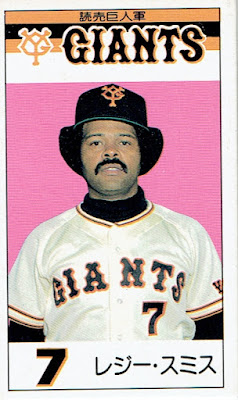
1984 Takara Kids Giants #7 Reggie Smith

1986 Takara Hawks #60 Hiromitsu Kadota

1987 Takara Tigers #44 Randy Bass

1988 Takara Dragons #6 Hiromitsu Ochiai

1989 Takara Whales #1 Motonobu Tanishige

1990 Takara Buffaloes #11 Hideo Nomo

1991 Takara Swallows #27 Atsuya Furuta

1992 Takara Carp #33 Akira Etoh

1993 Takara BlueWave #51 Ichiro Suzuki

1994 Takara Marines #18 Hideki Irabu

1996 Takara Lions #32 Kazuo Matsui

1997 Takara Giants #55 Hideki Matsui

You've probably noticed that the front design on a lot of these cards look similar to each other.  Takara used roughly the same design from 1984 to 1995 with the exception of 1988.  The 1981 to 1983 sets also used a similar design, as did the 1997 and 1998 sets.

Sunday, July 13, 2025

Card Of The Week July 13

Yudai Ohno of the Dragons pitched a complete game against the Carp yesterday, throwing 108 pitches while giving up four hits and only one run.  Of course, with this being Chunichi we're talking about, it's not a silly question to ask if the Dragons won the game.  They did, by a score of 7-1.  Here's Ohno's card from the 2021 BBM 1st Version set (#220):

Sorry for the lack of posts lately.  We've got some family visiting this week and I've been doing a bunch of work around the house to get it ready for them.  I've also been working on a post off and on for the last month or so that I hope to finally publish in the next few days.  And hopefully I'll be getting my latest shipment from Ryan in the next few weeks.  So things will probably pick up soon.

Sunday, July 6, 2025

Card Of The Week July 6

Kento Inoue of the Baystars hit his first career home run at the ichi-gun level last Wednesday and he made it count.  It was a grand slam off of Dragons' ace Hiroto Takahashi in the bottom of the first that accounted for all of DeNA's runs in their 4-3 victory.  Inoue was the 94th player in Japan to hit a grand slam for their first ever home run.  Here's Inoue's rookie card from last year's BBM 1st Version set (#081):


Friday, July 4, 2025

Summertime Things

Summer has arrived and I realized that I'd gone about a month and a half since I last did a roundup of new set announcements.  Time to fix that so here goes...

- Epoch has announced three more of their team sets under the "Premier Edition" label.  The Dragons set will be out on July 19th, the Buffaloes set will be out on August 16th and the Baystars set will be out on August 30th.  This will make it eight teams that Epoch has done these team sets for this year, with only the Giants, Hawks, Marines and Eagles being left out.  The Dragons set has 44 cards in its base set - 40 for active players, one for the mascot Doala and three for members of the coaching staff (I assume they'll feature photos of them from when they were active players and not coaches).  The Buffaloes and Baystars base sets are split between active and OB players with the Buffaloes set having 39 active players and three OB players and the Baystars set having 47 active players and seven OB players.  (I should mention that the "active players" group includes each team's manager as well.)  There's a "holo" parallel for every base set card in all three sets.  Each set has the same batch of inserts as all the rest of the "Premier Edition" sets - three varieties of "Regular Foil Signature" ("silver", "gold" and "hologram") (18 cards each), two varieties of "Regular Decomori Signature" ("hologram" and "hologram parallel") (18 cards each), five varieties of "Time To Shine" ("A","B","C","D","E") (six cards each) and three varieties of "Decomori Signature" ("gold","green" and "hologram") (six cards each).  I believe all of the inserts are serially numbered.  There are also the "GEM" and "BLACK GEM" "special insert cards" (twelve cards in each) that I think are much more limited.  Finally, each set has a bunch of associated autographed cards that are slightly different between the sets.  The Dragons set has 41 "Authentic Autograph" cards, four "Star Autograph" cards, eight "Rookie Autograph" cards, three "Legendary Autograph" cards, two "Combo Autograph" cards and four "Rookie Combo Autograph" cards along with an autographed card of Doala entitled "Doala's Flip".  The Buffaloes set has 39 "Authentic Autograph" cards, six "Star Autograph" cards, twelve "Rookie Autograph" cards, two "Combo Autograph" cards and an unspecified number of "Legendary Autograph" cards (but presumably three or less, assuming these are all for the OB players in the set).  The Baystars set has 44 "Authentic Autograph" cards, four "Star Autograph" cards, nine "Rookie Autograph" cards, seven "Legendary Autograph" cards and three "Combo Autograph" cards.  

- Epoch will be releasing their annual Pacific League Rookies box set on August 30th.  This year's edition will have 40 cards - a 37 card base set, two "special" cards that may be either foil facsimile signature parallel cards or GEM insert cards (both of which would be serially numbered) and one autograph card.  The base set is made up of all of last falls draftees from the six Pacific League teams with the biggest name being Rui Muneyama of the Eagles.  There are three types of autographed cards available of all 37 players and the first round picks also have a "baseball" autograph.

- BBM is releasing the third installment of their set to celebrate the 75th Anniversary of the Saitama Seibu Lions.  While the two previous parts were 36 card box sets, boxes for the Lions 75th Anniversary Series Vol.3 set will contain 37 cards - a 36 card base set plus one "special insert card" which could be either a facsimile or authentic autograph.  The base set will include 19 OB players from the 1990's and 2000's and 17 current players (each of the players currently on the Lions' roster will eventually be included in one of the four sets).  The set will be out in late July with the final part arriving in September.

- BBM's annual cheerleader/dance squad set called "Dancing Heroine" will be released in late August.  Like last year, this will be released as one set this year instead of the two installments - Hana and Mai - that BBM had done previously.  The set will be around 180 cards.  As usual the set only includes members of the squads from the Giants, Tigers, Swallows, Dragons, Hawks, Fighters, Marines, Eagles and Lions and, as usual, I have no idea why the ones from the Buffaloes and Baystars are not included (the Carp don't have cheerleaders).  There a holo parallel of all the base set cards and an 18 card "Two-shot" insert set.  There are also autographs and "cheki" cards available.  

- BBM's annual high-end set - Genesis - will be released in early October, a little later than normal.  As usual the base set contains 120 cards - ten per team which splits up as nine player cards and a team checklist.  Also as usual, no one really cares about the base set as the attraction of Genesis is the autograph and memorabilia cards available in the boxes.  The different varieties are too numerous to list but there are booklets, super patches, ball autographs and multiplayer autographed memorabilia cards.  There's also a myriad of parallel versions of all the base cards and five "High-grade insert card" sets - Elite Of Nine, Game Changer, Unrivaled, Cross Ocean and Combo Cross Foil Signing.  

- I realized that I missed writing about the new SCC KBO League Collection Card set which was released back in May.  The base set (the "Normal" cards according to SCC) has kind of a unique twist that I don't think SCC (or anyone else for that matter) has done before.  Each of the 140 active players (14 from each team) featured have two cards in the set - one showing them in their home uniform and one showing them in their away uniform.  In addition to the 280 cards for active players, there's also 11 cards of OB players which brings the size of the base set to 291.  There are also 90 "Puzzle" cards available - nine for each team which form a 3x3 puzzle featuring nine players from the team - and 81 "Hologram" cards - 7 from each team plus one for each of the 11 OB players.  There is a parallel version of the "Hologram" cards as well,  There's also 30 "Clover" cards - three from each team.  These appear to be some sort of partially transparent card.  There are 81 autographed cards available which have a similar breakdown as the "Hologram" cards in that most teams have seven of them and there's one for each of the OB players.  The big difference (other than not every active player who has a "Hologram" card has an autographed one and vice versa) is that for some reason there's eight autographs for Kia but only six for Kiwoom.

The title of this post was inspired by a song I heard Chuck Prophet do live a little over a month ago (even though one of the sets came out in the spring and one of them is scheduled for the fall):

Thursday, July 3, 2025

Twice In A Week

I got Zippy Zapped yet again!  I received another envelope in the mail yesterday from Kenny in Japan.  This one contained only one baseball card, a DreamOrder card of Akiyoshi Katsuno of the Dragons.  This was from last year's Central League Booster Pack Vol. 1 set and is #CBP01-C03.  It's also very shiny but it still seems to have scanned pretty well.  I assume it's shiny-ness means it's a good card to use in the game but I have not learned how to play it.

So thank you once again for the card, Kenny!