Friday, March 14, 2014

Nittaku Home Flyers And The Amazing Technicolor Uniforms

In a post the other day,  I pointed out that the Nittaku Home Flyers, the 1973-only stepping stone between the Toei Flyers and the Hokkaido Nippon Ham Fighters, had apparently trotted out the idea of having each player wear a different uniform on the field depending on which position they were playing.  Greg Dunn commented on the post asking if all the outfielders wore the same uniform and if a player changed position, did he have to change uniforms (which would make double switches time consuming).  As a result, I started doing a little more research into this and (as usual) the more I learned, the less I discovered that I actually knew.

Let's start with the one thing that I'm pretty sure about - the regular uniform for the 1973 Nittaku Home Flyers looked like this:


"The History Of Uniform" page 238
I think at some point in the season, the Flyers decided to roll out seven different alternate uniforms.  From what I can tell from the following pages from "The History Of Uniform", it appears that three of the uniforms were for away uniforms and four were home uniforms:

"The History Of Uniform" page 239

"The History Of Uniform" page 240

"The History Of Uniform" page 241

I'm basing this assumption on the text in the little green circles on the pages.  The same text in the circle next to the home uniform on page 238 appears on pages 240 and 241 and the same text in the circle next to the away uniform appears on page 239.  This kind of makes some sense as the away uniforms are colored but the home uniforms have a white base.  So I think this pretty much refutes the idea that every player on the field was wearing a different uniform based on which position they were playing.

But just to throw some more evidence against that idea, let's look at the two pictures I have of players modeling the uniforms (both of these pictures were taken from a mook - magazine/book - that BBM published last year on uniforms from 1934 to 2013):


The top picture shows (from left to right) Isamu Nakahara (pitcher), Hideaki Watanabe (pitcher), Tsuyoshi Oshita (2b), Makoto Fujiwara (pitcher), Masatoshi Nakahara (SS-3b), Takeaki Yamazaki (pitcher) and Masaki Miura (pitcher).

The bottom picture shows (from left to right) Masayuki Dobashi (mgr), Masaki Miura (pitcher), Naoki Takahashi (pitcher), Shoji Miyazaki (pitcher), Hideaki Watanabe (pitcher), Satoshi Niimi (pitcher) and Isao Harimoto (outfield).

Given that both pictures show Watanabe and Miura wearing the same uniforms, they were probably taken at the same time.  Dobashi didn't become manager until mid-season so I suspect the uniforms weren't rolled out until late in the season (but Dobashi was a coach with the team before becoming manager so that's not definite).  But what's interesting is that eight of the eleven players in the two pictures are pitchers.  That could be just because they were available to model the uniform or it could be further evidence that it didn't matter what position a player was playing.

The only game action photos I've been able to find are on some of the 1973 Calbee cards over at Fighter's Collection web site.  All the pictures appear to show the white with orange edging uniform.

So my hope is that someone who can read Japanese can take a look at the text on pages 239-241 from "The History Of Uniform" and tell me what's going on with these uniforms.

One other interesting thing I discovered while I was researching this was that the owner of the Nittaku Home Flyers had proposed a merger with the Lotte Orions.  The Orions were having issues finding a permanent home stadium following (I think) the bankruptcy of Tokyo Stadium in 1971.  Although I had read that they were playing at Miyagi Stadium in Sendai, apparently they were actually playing games in several ballparks.  It's hard to follow the Wikipedia article, but it looks like there might have been another team or teams involved in the potential merger as well.  I think the idea was to get NPB down to 10 teams in one league (so everyone could play the Giants), similar to the discussions when Orix and Kintetsu first discussed merging in 2004.  I had never heard about this possibility before.  Obviously nothing came of it and the Flyers owners sold the team to Nippon Ham who has owned it ever since.

Wednesday, March 12, 2014

2013 Box Sets

Among the goodies I got from Ryan of This Card Is Cool were nine box sets from last year.  Five of those sets were produced by "Front Runner Trading Cards" (or Frontier International) and will be the subject of another post, hopefully in the next few days.  This post will concentrate on the remaining four sets.


The first set was a single player set BBM released last spring dedicated to the recently retired Hideki Matsui.  This was a 36 card set entitled "Memories Of Matsui".  The set is a fairly typical BBM single player set - the first 27 cards give his life story.  There is one card each devoted to his childhood, his high school career, his being drafted by the Giants and each of his 10 years playing in NPB.  Several significant events (first hit, first home run, winning the MVP, etc) are also the subject of cards.  Other cards are devoted to his uniform number, his All Star appearances, his stolen bases, he and Shigeo Nagashima (his manager with the Giants for all but his last year) and so on.  The final nine cards in the set show his swing through a sequence of pictures.

It's a nice little set although probably not as nice as the "Legend Of Hideki Matsui" set that BBM did back in 2002.  But this set is probably a bit more attainable that that one at this point.

Here's a couple sample cards (you can see all of them at Jambalaya):

#1

#12

#18


BBM released the third of their Greatest Games box sets last summer and this one dealt with the climactic game of the 2001 season between the Osaka Kintetsu Buffaloes and the Orix Blue Wave.  The game was played at Osaka Dome on September 26, 2001.  The Buffaloes won the game which clinched their first Pacific League pennant since 1989.  The reason the game is considered one of the greatest in NPB history is that the Buffaloes were trailing 5-2 in the bottom of the ninth.  Here's what happened next (h/t Ryan for the video):


The Buffaloes loaded the bases and Hirotoshi Kitagawa hit a pinch hit walk off grand slam to put the Buffaloes into the Nippon Series.

The set is the nicest looking of the Greatest Games sets so far (including the Tigers/Swallows 1985 set that came out in December).  The pictures are all clear and well-lit - probably since the game was inside (I am assuming that all the pictures came from the actual game but that may not be the case).  The set has 36 cards in all - 15 Blue Wave players, 17 Buffalo players and four cards devoted to "2001 Buffaloes Highlights" (which were Norihiro Nakamura's great season, Tuffy Rhodes hitting 55 home runs to tie the then single season record, Kitagawa's grand slam and the Buffaloes winning the pennant - and yes, the last two seem a bit redundant).  It's not exactly a star studded set - although Yoshitomo Tani, Rhodes, Nakamura and Akinori Ohtsuka are included, Hisashi Iwakuma and So Taguchi are not (presumably because they didn't play in the game).  Both managers (Masataka Nashida and Akira Ohgi) are in the set as well as several Westerners - George Arias, Sean Bergman, Shawn Gilbert, and one of the very few Japanese cards for Joe Vitiello.  There's kind of an irony about the two teams being featured as three years later they "merged" into the current Orix Buffaloes team.

Ryan had done a post last fall showing three cards from the set - here's three others (and Jambalaya has all of them):

#12

#22

#33


It's pretty rare when I pick up one of BBM's team sets and even rarer when I pick up one of BBM's team box sets, but I was taken by how attractive the "Bright Carp" set was when I saw the cards on Jambalaya last fall and asked Ryan to pick it up for me.  There's only 18 cards in the set but most of the Carp stars are included - Kenta Maeda, Yusuke Nomura, Shota Dobayashi, Kan Ohtake and Takeru Imamura as well as foreigners Fred Lewis, Brian Bullington, Brad Eldred and Kam Mickolio.  The card design is not usually one that I like - I prefer action photos with full backgrounds - but somehow this set just looked too attractive to pass up.  Ryan again did a post on this set when it came out last fall so I'm just going to show one card here:

#03


The final box set for this post is not from BBM but instead one of the sets Epoch has been doing in the past few years with the All Japan Baseball Foundation/OB Club/Japan Baseball Promotion Association.  This particular set is dedicated to Rookie Of The Year award winners.  There are only 40 cards in the set so it is not a comprehensive set of all Rookie Of The Year award winners.  The earliest winner is Futoshi Nakanishi (1952) while the latest is from 1998 (Tetsuya Ozeki).  As you might expect, there's a large number of stars in the set - Shigeo Nagashima, Isao Harimoto, Tsuneo Horiuchi, Tatsunori Hara, Akinobu Okada, Yasushi Tao, Kenichi Yazawa, Michiyo Arito and Hiromichi Ishige.

It took me a long time to decide if I wanted to get this set.  I don't particularly like the Epoch sets as I feel the same players seem to show up in them over and over and the cards frequently aren't terribly attractive.  I feel that this particular set suffers from way too many black and white photos - only three of the pictures are in color.  On the plus side, it appears that Epoch made an effort to get pictures of the players from the year that they actually won the award.  As a result, there's a couple incarnations of teams that don't get seen very often that appear in this set - the Yakult Atoms and the Nittaku Home Flyers:

#08

#29
The team that is now the Tokyo Yakult Swallows was known as the Atoms from 1966 through 1973.  The team that is now the Hokkaido Nippon Ham Fighters were known as the Nittaku Home Flyers for one season (1973) after Nittaku bought the team from Toei.  They sold the team the following year to Nippon Ham who renamed them the Fighters.  Beyond Niimi's award, Nittaku's single season owning the franchise is most memorable for their ill conceived decision to try a fashion experiment in which the players wore different uniforms on the field depending on which position they were playing, resulting in this travesty:


That's Hall Of Famer Isao Harimoto (#10) on the far right, wishing he was somewhere else.

Anyway, I think Ryan found me a set for 100 yen (roughly $1) at Mint Akihabara so I really can't complain too much about the set.  You can see all the cards in the set either at Ryan's post or at Jambalaya.

Sunday, March 9, 2014

Card Of The Week March 9

Dr. Frank Jobe, the surgeon famous for developing the pitcher career saving procedure known as "Tommy John surgery" passed away last week at age 88.  Among the pitchers who Jobe helped was Japanese Hall Of Famer Choji Murata, who was the first NPB pitcher to opt for the surgery.  Murata faced a lot of criticism at home for having the surgery but he was able to successfully pitch another six seasons afterwards.

What's funny is that now, 30 years after he got the surgery, Murata is still apparently able to throw his fastball in the 80 mph range.  Deanna Rubin had reported seeing him hitting 83 mph in a old timers game a few years back and Patrick Newman over at NPB Tracker had done a post a few months back on this odd New Year's Eve program where Murata (and a couple other pitchers) were taken on by Kazuhiro Kiyohara in an attempt for Kiyohara to hit a home run for his mother.  Murata once again was hitting 83 mph on his fastball.  To paraphrase what people used to say about Tommy John, Murata might be 64 years old but his elbow is only 30...

Here's Murata's 1977 Yamakatsu JY3 card:


Saturday, March 8, 2014

2001 Calbee Pack Busting


I bought a lot of 50 2001 Calbee packs off Ebay last week and I thought I'd do a post on what I got.

The seller actually sent me 51 packs.  They were all from 2001 Series One.  That set had 72 regular player cards (doesn't look like that broke down evenly between teams), 18 "Title Holder" cards, 16 "Best 9" cards (for the 2000 Best 9 team less Ichiro, Tsuyoshi Shinjyo and Bobby Rose), 8 "Olympic Team" cards, 11 "2000 Nippon Series" cards and six checklist cards.  There were also some sort of mail in prize cards (which obviously I didn't get any of).

I didn't do too badly on the 51 packs - I got 40 unique cards.  It broke down to 26 player cards, 4 "Title Holder" cards, 2 "Best 9" cards, 2 "Olympic Team" cards, 4 "2000 Nippon Series" cards, one checklist card and one card that's not really a card but some sort of mail in thing - it might be what you send in to get one of the prize cards but I'm not sure.  I was a little bummed that I got three of the "prize" cards as they really don't do me any good now.  I also thought it was odd that I ended up with three Shingo Ono cards.  On the plus side, I didn't previously have any of these cards with the exception of the "Olympic Team" ones, so that's 38 new cards for my collection (well, 37 not including the "prize" card).

Here's some of the cards:

#003

#008

#022

#032

#058

#T-03

#B-04

#J-04

#N-04

The check list cards formed a two by three puzzle.  The back of each card showed where that card fit in:


Lastly, here's one of the promo/prize cards.  Maybe someone who can read Japanese can tell me what it is:


Yet More New BBM Sets

Information on five new BBM sets hit the web this past week:

- Lasr year BBM did a box set called "Icons - Hope" that contained cards of what BBM felt were the most hopeful young players for each team (24 players in all - two per team).  This year the "Icons" set is back with a new theme - "Big Guns".  The box set features 28 cards (27 "regular" cards plus a "special" card - possible autograph or die-cut cards) showcasing power hitters for all the teams.  If BBM puts it together like last year's set, the set will contain 24 single player cards (two per team) and three combination cards.  It will be released in late March.

- BBM's latest single player set is for Shota Dobayashi of the Carp.  The box set (entitled "Breakout") contains 28 cards - as usual this is 27 cards for the base set and one "special" card.  The "special" card could be a foil autograph card, a bat card or I think a real autograph done a card that uses a "Carp design from yesteryear".  I think the possibilities for that card design are the Carp sets from 2004, 2006 or 2007.  The set will be out in late March.

- BBM announced the first team sets for the year - the Hawks, the Swallows and the Carp.  At 90 and 81 cards respectively, the Hawks and Swallows base sets appear to be a little smaller than what's been the normal size of the non-Giants or Tigers team sets recently.  The Carp base set is the expected 99 cards.  The Hawks and Swallows sets will be out in late March.  The Carp set will be out in mid-April.

Tuesday, March 4, 2014

Suk-Min Yoon of the Baltimore Orioles

Somehow in all the snow and everything in the last few weeks it kind of escaped my notice that Suk-Min Yoon, formerly of the Kia Tigers in Korea, had signed with the Baltimore Orioles.  It's a little out of scope for me but I figured I'd do a quick post on what baseball cards there are out there for him.

Being as there don't appear to be many Korean baseball cards, that list is pretty short.  He only has one card that I'm aware of depicting him with the Tigers - card #AL-005 from the 2010 KBO game set:


He played for the Korean national team in the 2008 Olympics and the 2009 and 2013 World Baseball Classics.  He has several cards for the 2009 WBC - a Bowman Chrome card (and assorted parallels) and two cards from the Konami WBC Heroes set (a regular card and a "Special" card).  He also had a card in the 2013 Topps Tribute WBC set.  I don't have the "Special" Konami card but I have the other three:

#BCW51

#W09R122

#76

Monday, March 3, 2014

2014 BBM Farewell Set


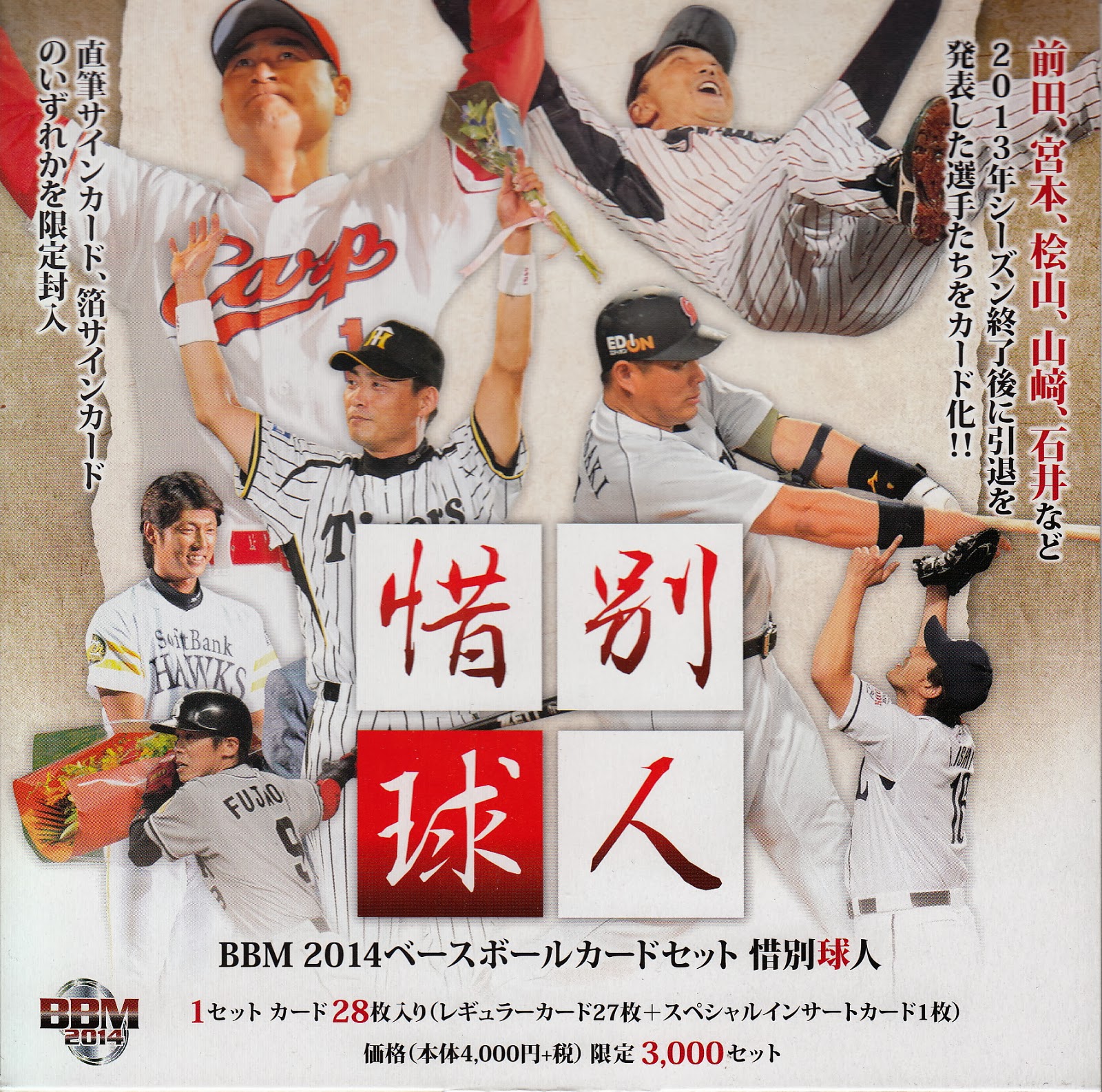
One of the sets I got from Ryan the other day is my first BBM set for 2014 - the "Farewell" set.  This is the fourth annual edition of this set which is dedicated to the players who retired at the end of the previous season.  This used to be an annual subset in either the 1st or 2nd Version sets (or both) but BBM started doing a separate box set for this theme in 2011.

Ryan did a post on this set last month where he mentions that the set's official name is "Sekibetsu Kyuujin" which he says roughly translates to "Regret at Parting Ball Players".  Maybe we should call this set "Sorry Goodbye" instead.

This year's edition features 21 players on 27 cards.  Six players have more than one card in the set - Shijnjiro Hiyama, Kazuhisa Ishii, Tomonori Maeda, Shinya Miyamoto, Kazumi Saitoh and Takeshi Yamasaki.  The picture used for the player may have been taken any time during his career - I think BBM tries to get the player shown with their most representative team.  So Takayuki Shinohara is shown as a Fukuoka Daiei Hawk even though he played his last four years with the Baystars (and the Hawks haven't been owned by Daiei since 2004).

Here are some sample cards.  As always, you can see the whole set at Jambalaya.

#14

#24

#06

#02