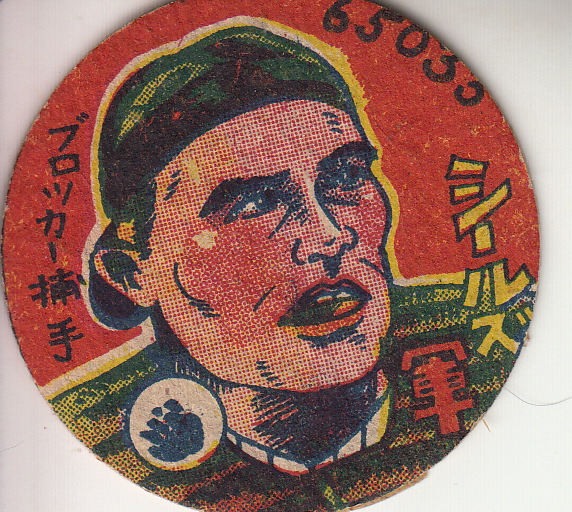
If you read any edition of Gary Engel’s “Japanese Baseball Card Checklist & Price Guide” you’ll see a couple references to Bud Ackerman and Mel Bailey who are credited with importing several sets of Japanese cards to the United States during the 1960’s. I'd always been a little curious about these two men but unfortunately Engel has very few details about the pair. Luckily Ralph Pearce met and interviewed both of them in the early 1990’s for his newsletter, “The Japanese Baseball Enthusiast”. Ralph has been kind enough to make copies of his newsletters for me so those are my primary sources for the following post.
Bud Ackerman
Chief Petty Officer Bud Ackerman was stationed with his family at the US Navy’s base in Sasebo, Nagasaki prefecture on the island of Kyushu in the early 1960’s. He learned that Japanese baseball cards existed when “my wife was walking the narrow streets of Sasebo, Japan and she saw these cards for sale in the little shops that you see in the alleys of Japan. So she came home and told me about them.” He was a card collector and had seen ads selling baseball cards in “The Sporting News” so he decided to try selling Japanese cards that way.
At first Ackerman obtained the cards he was selling through those same alley stores that his wife had first seen the cards in. But then a Japanese neighbor offered to help him out. “He said he could get me a whole bunch reasonable by going to a wholesaler. So he came back with an offer of about 10,200 card for $10.00.”
Ackerman was in business except that he had a problem: he had “jillions of cards and they were on sheets of 16”. He enlisted his wife to cut the sheets into individual cards (“I think she used scissors, but we may have borrowed a paper cutter”) and they assembled the sets and numbered them. “There were no numbers on these things that we could decipher” so he had his son stamp numbers on the back of the cards. His neighbor translated the names on the cards and produced a list of the players, along with information like their uniform number, team, height and weight. Ackerman included copies of the list with the sets that he sold.
 |
| A section of a 1963 ad from Bud Ackerman (From the Collection of Ralph Pearce) |
Ackerman's Menko
Ackerman eventually imported what he referred to as six separate sets but Ralph and I think that these sets actually correspond to five sets that are catalogued in Engel. The first two sets had stamped numbers on the back but the remaining four had letters or a letter/number combination pencilled on the back.
This first set that Ackerman sold has been catalogued by Engel as "JCM 13c 1963 Marusho Flag Back" and contains 40 cards. Here's the front and back of Masaichi Kaneda's card from the set - you can see on the back where Ackerman's son stamped "35" on it:
There are no known cards for this set that were not imported by Ackerman. However this is a fairly common set in Japan as well so it's not unusual to come across a card from this set that wasn't stamped. I personally have eight cards from this set - half have the stamped numbers and half don't.
Ackerman found and began selling a second set that is now known as "JCM 11 1964 Marusan Simple, Navy Blue Back Photo Menko". This set contained 28 cards and Ackerman had his son continue the numbering that they had started with the previous set so the cards are numbered 41 to 68. One odd thing about this particular set is that Ackerman had more of certain cards that others. As a result he ordered the cards so that the more common cards had lower numbers. Because of this the final 12 cards (#s 57 to 68) are scarcer that the first 16 (#'s 41 to 56). Actually according to Paul Margiott's checklist for the set in “The Japanese Baseball Enthusiast”, there are different levels of scarcity in those final 12 cards as well as "research indicates #56-62 are scarcer, #63-65 are very scarce and #66-68 are extremely scarce." Here's the front and back of Katsuya Nomura's card from the set, again showing the number stamped on the back:


As was the case with the first set there are no known cards for this set that weren't imported by Ackerman but it's not uncommon to come across cards that don't have the stamped number on them. I have six cards from this set - half of which have a stamped number and half of which do not. It's possible that the scarcity issue is only a function of the cards Ackerman could get his hands on and not a function of the cards in general as two of the three unstamped cards I have are "scarce" ones.
Here's a list of the cards that Ackerman distributed with the sets. You can see there's only 62 cards listed so at this point he had sold out of the scarcest six cards from the JCM 11 set. You'll also notice many of the names are mistranslated (the worst being Sadaharu Oh being translated as "Sadaharu Wang") - I'm guessing his neighbor who translated the cards didn't necessarily know much about baseball. It's also interesting that the Orions are mistakenly listed as being from Osaka - at the time the team was known as the TOKYO Orions.

There is considerable confusion on both Ralph's and my part regarding the remaining sets imported by Ackerman. He listed four sets in the ad I've included above - "A thru Z", "A1 thru Z1", "A2 thru Z2" and "A3 thru Z3" - I should correct that to say four sets in addition to what I think are the first 42 stamped cards from the previously mentioned sets (40 from JCM 13c and 2 from JCM 11) but I don't know that for sure. It appears that each of those four sets contained 26 cards as he offers a total of 146 cards if you buy all of them and 26 time 4 equals 104 and if you add the 1-42 card set you get 146 cards. Ralph and I think we've identified which sets in Engel these sets correspond to but the numbers don't quite add up right.
The "A thru Z" set appears to correspond to the 1962 Marusho JCM 13b set. Here's the front and back of an example card (Jim McManus) - you can see the letter "A" appears in pencil on the back of the card:
Engel lists this as being a 40 card set but Ackerman's listing only accounts for 26 cards. Did he only import 26 cards from it?
Ralph and I think that both the "A1 thru Z1" and "A2 thru Z2" cards correspond to the 1962 Marukami JCM 14e set. Here's the front and back of an example card (Minoru Kakimoto) - note the pencilled numbers on the back - either "U2" or "V2". I believe someone who had the card after Ackerman sold it added the "Minoru" at the top of the back.
Engel's listing for this set makes this match even more confusing than the previous set - it only has 40 cards but Ackerman's two sets account for 52 cards! Where did the other 12 cards come from? I'm assuming that there aren't 12 cards from this set that are unknown to Engel as it's doubtful that any 1960's cards imported to the US would have escaped his knowledge.
Ralph believes that the final set - "A3 thru Z3"- corresponds to the 1962 Marusan JCM 10 set. I don't have any cards from this set that have markings on the back so I can't corroborate this.
Mel Bailey
Ackerman returned to the United States in early 1964, apparently to a new assignment in the Washington, DC, area as the address he used for correspondence and selling cards was in Vienna, Virginia. However a new American arrived in Japan in May of 1965, determined to follow in Ackerman's footsteps - Mel Bailey. Bailey was a Captain in the US Air Force stationed at Fuchu Air Base in Fuchu, Tokyo prefecture.
Bailey had been in contact with Ackerman and was planning to locate more cards for the two of them to sell. Bailey thought "it would be no problem to get the annual issues [of menko] when we started a three year tour in Tokyo". But it turned out to not be easy. He went to store after store but could not find any cards.
He eventually came across a small plastic baseball and bat package at a toy store near where he was living. The package contained baseball cards of Katsuya Nomura and Kent Hadley of the Nankai Hawks. He didn't believe that these were cards that Ackerman had previously imported so he took them around to other toy stores, especially in the Asakusa area of Tokyo. At each store he asked if they had anything like these cards and he was constantly told they didn't. Finally at a store called Ishikawa's he got a "maybe". They said they didn't have any but they might know a place if he came back in a couple days.
When he returned a few days later he was taken across the Sumida river to the "card factory" (really just a house) where he was soon "standing next to stacks of menko cards piled from floor to ceiling. Non-baseball menko." However the woman running the place "went upstairs and came back with a bundle of 8,000 pairs of cards, including the Nomura and Hadley ones. Then they brought sheets of 16 cards, about 300 of them." In addition they brought out a different set with "poorer printing" that was cut into sheets of 12.
From looking at the cards, Bailey was able to establish that these were not cards that Ackerman had imported. He noticed that the cards included a card of Masaaki Koyama with the Tokyo Orions. Bailey knew that Koyama had been traded from Hanshin to the Orions before the 1964 season so it was unlikely that Ackerman had previously seen these cards.
His next problem was determining how much this was going to cost. He made a call back to his base and got one of the Air Force interpreters to handle the negotiation. Eventually Bailey ended up with "a 37-pound bundle with 23,000 menko cards for 6,600 yen ($18 in those days of 360 yen to the dollar) or a cost of .00079 per card".
Bailey's Menko
Bailey had ended up with cards from two separate sets. He cut up the 12 card sheets to create a 30 card set. The 16 card sheets were cut up to create a 40 card set. (There was a lot of "duplicate strips" on the uncut sheets which is how the numbers work out.)
The 30 card set is what is now known as the 1963 Marukami JCM 14f set. Unlike Ackerman, Bailey did not stamp or write any numbers on the back of the sets he imported. There are 10 cards for this set that are known about now that Bailey did not import. Here's a sample card (of one of the ones he imported) - this is Masaaki Koyama when he was still with the Tigers:
The 40 card set is now known as the 1964 Marukami JCM 14g set. Bailey didn't add numbers to the back of this set either. There aren't any known cards for this set other than what he imported. Here's the front and back of an uncut sheet of 16 cards from the set like what Bailey found (or at least as much of it that would fit in my scanner) - the Nomura and Hadley cards he had found in the package with the plastic bat and ball are the first two cards in the third row and the Koyama on the Orions card that told him the set was from 1964 is the second card in the fourth row:
You might notice that the two sets look very similar.
The primary difference in the cards is that the 1963 cards have the player's name and team name on the back while the 1964 cards only have player's name on the back.
Fujiya & Morinaga
What Bailey didn't know yet was that his timing was bad - 1964 was pretty much the last year that menko baseball cards were produced so there weren't any new issues to find in 1965. He did come across some other cards sets however.
The first non-menko set he found was a 10 card set issued in 1964 as a promotion by Fujiya, "one of Japan's largest chewing gun manufacturers". The set included three cards of Shigeo Nagashima, two cards of Sadaharu Oh and one card each of Shinichi Eto, Kazuhisa Inao, Masaichi Kaneda, Minoru Murayama and Katsuya Nomura. The cards were larger than the menko cards - about 4 3/4 inches by 3 1/8 inches - and were blank backed.
Bailey had only found the set at a single candy shop, despite claims by the manufacturer that "literally millions were printed". He bought out their entire stock although he later related that he didn't think he was able to put together more than 30 sets total. He had fewer of one of the Nagashima cards than so he and Ackerman started selling them as a nine card set.
Engel lists this set as the 1964 Fujiya Gum JF 3 set. There are not any additional cards known for this set that were not imported by Bailey. Here's the Eto card:
Bailey came across his next set in a kind of interesting manner. He was assigned the duty of gathering donations from Japanese companies for orphanages in Vietnam (where the US involvement in the war was starting to escalate). One of the companies he contacted was Morinaga, another gum manufacturer. Morinaga donated 15 or 20 cases of Top Star Gum which included a bunch of baseball cards. Bailey knew that the Vietnamese orphans would have no interest in the cards and he put them aside to sell.
The cards were originally distributed to candy stores in groups of ten with boxes containing 20 packs of gum with the idea that they would be given away to customers who bought two packs of gum. The cards again were larger than the menko cards as each card was 3 1/2 by 5 1/2 inches. One unique feature of the cards is that they had a little easel that folded out of the card, allowing it to stand up on its own.
Bailey estimated that he had about 100 sets altogether. Originally he and Ackerman sold them as 12 card sets but since he again had fewer copies of one card (Shigeru Mizuhara) they eventually started selling it as a 11 card set.
This set is listed in Engel as the 1964 Morinaga Standups JF 1 set. There are five additional cards that are now known from this set that Bailey did not import. Here's the front and back of Futoshi Nakanishi's card - notice that the back has instructions for folding out the easel:
Kabaya-Leaf
The Kabaya Foods Corporation is a confectionary company that was founded in Okayama in 1946. They are known for several product lines of chocolate candies, gummy candies and cookies. In 1967 they entered a joint venture to produce baseball cards for NPB with the Leaf company of Chicago, Illinois. The resulting set was the first set in Japan that truly resembled MLB cards from North America - the cards were nearly the same size as American cards and had the player's biographical information as well as yearly statistics on the back of the card.
There are 105 cards known to exist for the set. Only six teams are included in the set - the Giants, Tigers, Dragons, Lions, Hawks and Flyers. I don't think it's a coincidence that these six teams were the top three teams in each league in 1966. The cards are skipped numbered so it's been speculated for years that perhaps a second series had been planned to include the other six teams but was cancelled due to disappointing sales. The fronts featured two different designs, one of which was very similar to the 1959 Topps design. Here's some example cards:
 |
| 1967 Kabaya-Leaf #55 (Nobuyuki Kadooka) |
 |
| Back of 1967 Kabaya-Leaf #55 (Nobuyuki Kadooka) |
 |
| 1967 Kabaya-Leaf #111 (Kingo Motoyashiki) |
The cards were sold in two different ways. Initially single cards of the Giants players were included in packs of "Air Bon Chocolate Balls". Later cards of all the players were included in packs of gum. Some of the gum packs contained a "lucky number" that could be redeemed for a five card pack.
Bailey first encountered these cards in their first incarnation. "[The Kabaya-Leaf cards] came to my attention in grocery stores. They came packed with chocolate drops. I should say that the ones that I saw were all the Yomiuri Giants players and I don't know if this was because we were in Tokyo or because the Giants were the most popular team in Japan. So, any chance we got in the grocery store we would buy these."
Eventually Bailey contacted the company and arranged to buy their remaining stock of cards. He ended up with 30,000 cards for a total of 21,700 yen which at the exchange rate of the time of 360 yen to $1 came to $60.28. Ralph Pearce shared some of Bailey's correspondence with the company with me:
 |
| From the Collection of Ralph Pearce |
 |
| From the Collection of Ralph Pearce |
Bailey enlisted his wife and sons to help create sets from the cards he had received. Here's a photo of the cards stacked up on the Bailey's dining room table:
 |
| Steve, Marty and Ed Bailey (Photo by Mel Bailey. From the Collection Of Ralph Pearce) |
What he discovered when attempting to put together the sets was that once again he had received an uneven number of cards. While he had about 300 each of most of the cards, there was one card (#7 Akira Takahashi) that he only had 200 of, five more (#1 Tetsuharu Kawakami, #4 Tsuneo Horiuchi, #6 Masaichi Kaneda, #14 Akira Shiobari and #18 Isao Shibata) that he only had 100 of and four cards that Kabaya had failed to give him ANY of (#2 Hideki Watanabe, #3 Kunio Junouchi, #8 Kazumi Takahashi and #17 Katsutoyo Yoshida).
There's no real explanation I'm aware of why these 10 cards were so much rarer than the others. Kabaya had included about 200 cards of Americans and other popular players but unfortunately Bailey "was stupid enough to throw [them] away because my mind was on complete sets." He was able to find copies of the four cards that Kabaya had not provided him with "by buying them in the grocery store. The way they were packaged, you could see who the card was you were getting in the box of candy. So, we knew which ones we were short, so anytime we saw those we'd pick them up. And I really can't remember how many of those I was able to get."
Bailey and Ackerman sold the sets for $4.00. Initially they sold the sets as 101 card sets but as they worked their way though the stock and ran out of cards they had to start selling the set as a 96 card set and then a 95 card set. Here's one of his sales sheets for the set:
 |
| From the Collection of Ralph Pearce |
Aftermath
 |
| From the Collection of Ralph Pearce |
The Kabaya-Leaf set was the final set that Ackerman and Bailey imported from Japan. Bailey and his family left Japan after his three year stint was up in 1968. The two of them continued to sell the cards that they had found until the early 1970's. Bailey continued to be involved in introducing Japanese baseball to the US for a number of years in the mid-70's as he worked with
Ed Broder on an annual "Foreign Player Register/Americans In Japan" guide for at least a couple years:
Some of the illustrations in these handbooks were images of either menko or Kabaya-Leaf cards. The back of the 1974 publication has an ad for Bailey selling both the 1967 NPB Baseball Yearbook he had self-published and menko cards from 1964:
Bailey had also taken photos at baseball games during his time in Japan and produced
post cards of the images.
Ackerman and Bailey had fallen out of touch with each other after they stopped selling cards. They were reunited by Ralph Pearce in 1995:
 |
| Bailey, Ralph Pearce, Ackerman (photo taken by Jeff Alcorn. From the Collection of Ralph Pearce) |
Ralph is holding the four ultra-rare Kabaya-Leaf cards (#2, #3, #8 and #17) in this photo. Ralph claims that Bailey joked that he was going to run him through a "paper detector" before he left the house.
Mel Bailey passed away in November of 2014 at age 81. Ralph last talked to Bud Ackerman in early 2013, a few months after Ackerman had celebrated his 90th birthday and moved into an assisted living facility. He'd be 96 years old now if he's still with us. The two men leave behind quite a legacy as they pretty much invented the Japanese baseball card hobby in the US. They were the first to attempt to sell cards to the American collectors market.
One interesting things to keep in mind about them is that two of the sets they imported - the 1964 Fujiya set and the 1967 Kabaya-Leaf set - are rarely if ever seen in Japan. The only reason these two sets are known and cataloged is because Mel Bailey found them (and Mel Bailey found them because Bud Ackerman had started selling menko cards). If you have a card from either set, chances are it was in Bailey's hands at one point. And if you have any Kabaya-Leaf cards, they're probably somewhere on that dining room table in that photo with his family.
References
I want to thank Ralph Pearce for his kind help with this post. Between providing me with copies of his newsletter and scans of supporting materials and his patient answering of my questions I would not have been able to write this. And in fact without Ralph I wouldn't have really known there was a story to be told here.
Bailey, Mel, "From The Sports Collector Whirl", "The Japanese Baseball Enthusiast" Vol I, No. 2, July 1993 (articles were originally in published in the 1960's)
Bailey, Mel, "Japanese Card Collector", "The Japanese Baseball Enthusiast" Vol I, No. 1, May 1993 (article was originally in a 1960's issue of "Ball Card Collector")
Bailey, Mel, Unpublished Monograph circa 1993 from the Collection Of Ralph Pearce
Holt, Mark "Collecting the 1967 Kabaya-Leaf Set" , "Sports Market Report", April 2018
Margiott, Paul, "'Simple' Back, Dark Blue Ink Menko Checklist", “The Japanese Baseball Enthusiast” Vol. II, No. 1, Jan. 1994
Pearce, Ralph, "1967 Kabaya-Leaf Interview with Mel Bailey", “The Japanese Baseball Enthusiast” Vol. I, No. 4, Nov. 1993
Pearce, Ralph, “Interview with Bud Ackerman”, “The Japanese Baseball Enthusiast” Vol. II, No. 1, Jan. 1994
Pearce, Ralph, "The Japanese Baseball Enthusiast" Vol I, No. 2, July 1993
UPDATE 6/5/19 - Ralph sent me a message letting me know I had been off by one on the card counts for the Morinaga set. Originally Bailey imported 12 cards not 11 as I originally stated and then sold them as 11 card sets when the Mizuhara cards ran out. I've corrected the text.